
Bonus Depreciation for Big Tax Relief: a free investor guide to how qualified short-term rental investors may use cost segregation and 100% bonus depreciation to accelerate deductions while building a luxury property portfolio designed for income, enjoyment and long-term wealth.
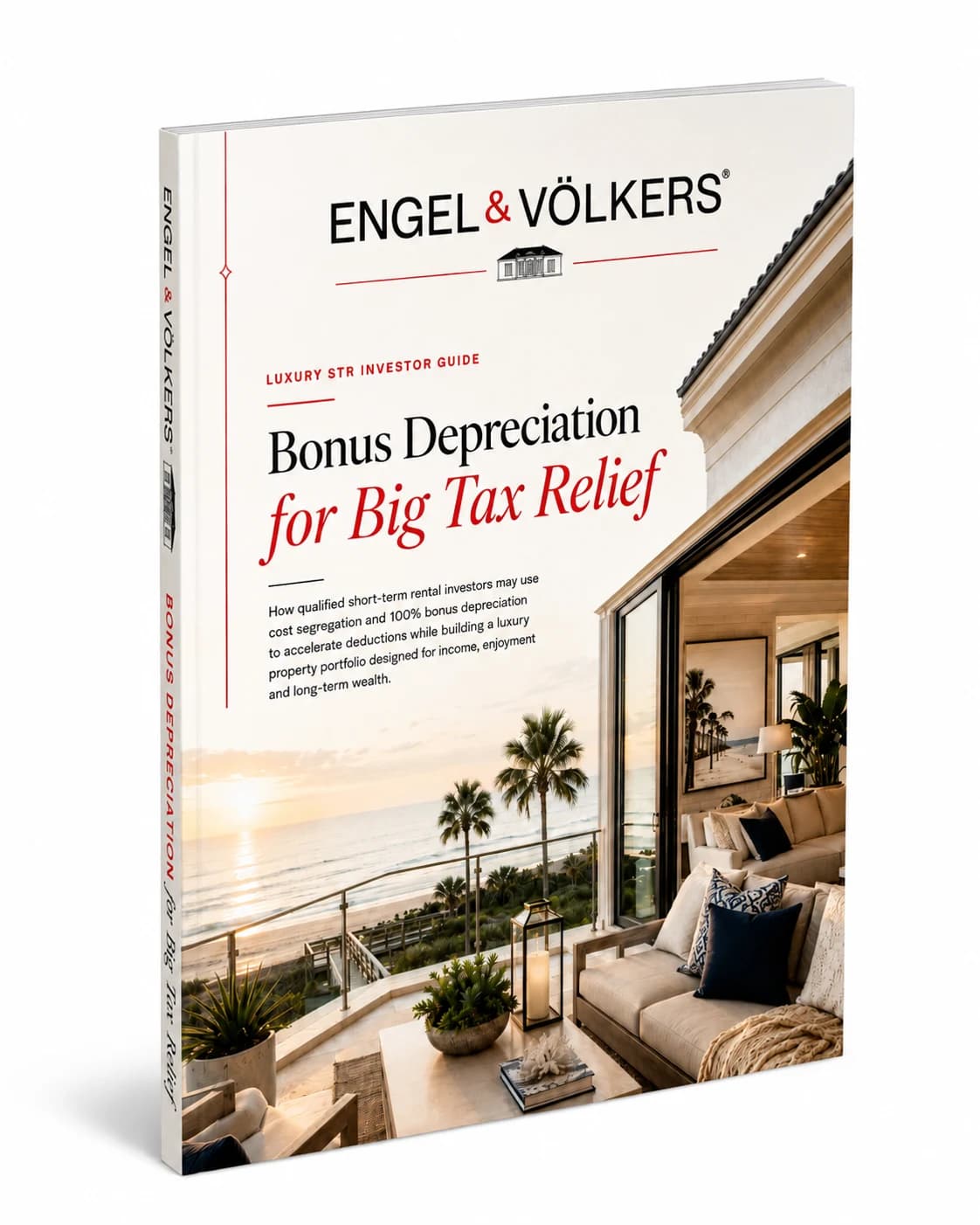
How qualified short-term rental investors may use cost segregation and 100% bonus depreciation to accelerate deductions while building a luxury property portfolio designed for income, enjoyment and long-term wealth.
23 pages, including the seven-day guest stay rule, the three material participation tests, a worked $750,000 example and a 10-step implementation plan.
Ready to talk it through? A complimentary 15-minute virtual consultation.
Book a Strategy Session with John ChinFrom Tax Concept to Investment Plan
Depreciation: The Foundation
Why a property can appreciate in the market and still generate deductions, and why land never depreciates.
Cost Segregation Explained
How one building becomes several tax lives, and why luxury properties often carry more short-life components.
100% Bonus Depreciation
What current federal law allows, what it does not cover, and why federal and state treatment can differ.
The Short-Term Rental Exception
The seven-day average guest stay rule, and why a listing on Airbnb or VRBO does not qualify a property on its own.
Material Participation
The 500-hour, substantially-all and 100-hour tests, plus the audit-ready record-keeping habit each one demands.
A $750,000 Property Example
First-year math worked through at 24%, 32% and 37% marginal rates, with every assumption stated.
The Turn-Key Wealth Model
Connecting property selection, financing, operations, guest experience and tax execution from the start.
What Can Go Wrong
Seven mistakes that unravel the strategy, from buying for the deduction to letting a manager outwork you.
Recapture and Exit Planning
Hold, 1031 exchange or sell and pay: how the accelerated deduction follows you to the exit.
The 10-Step Implementation Plan
From confirming strategic fit through placing the property in service and filing.
Investor Readiness Checklist
A conversation starter for your tax and investment team across financial profile, participation, property fit and professional team.
The Step-By-Step Experience
The investor journey from search and secure through design, compliance, launch and long-term performance tracking.
Material Participation Through Co-Hosting
Hour-by-hour tables for setup and ongoing owner participation, showing what a co-host can absorb and where the owner still has to show up.
Your Investment Snapshot
The $750,000 example recapped alongside capital planning, with the before-you-buy and before-you-file checks in one place.
A Luxury Short-Term Rental Can Be More Than a Vacation Residence
For many high-income buyers, taxes are the single largest annual expense. When a property is selected for real guest demand, operated as a genuine business and supported by the right tax strategy, one purchase may create four forms of value at once.
Cash Flow
Guest revenue can help cover debt service, operating expenses, reserves and ownership costs.
Tax Relief
A cost segregation study may identify short-life assets eligible for accelerated depreciation.
Long-Term Wealth
Loan amortization and potential appreciation can build equity over time.
Personal Enjoyment
Carefully planned owner use can create meaningful family experiences, subject to tax-use limits.
This is not a tax loophole property. It is a real investment that may receive unusually favorable tax treatment when every requirement is met. The tax benefit is the accelerator. The property and the operating plan are the engine.
Three Rules That Have to Line Up
Cost Segregation Identifies the Components
An engineering-based study breaks one building into several tax lives. Appliances, floor coverings, decorative lighting and furniture may fall to 5-year property. Landscaping, fencing, driveways and other site improvements may fall to 15-year. Higher-end vacation residences often carry more of both.
Bonus Depreciation Accelerates the Deduction
Current federal law generally provides a permanent 100% additional first-year deduction for certain qualified property acquired after January 19, 2025. It applies to those qualifying short-life components, not to the whole purchase price. The benefit is primarily about timing: deductions that would have been spread over future years move into the present.
The Short-Term Rental Rules Can Unlock It
Rental losses are ordinarily passive. When the average period of guest use is seven days or less and you satisfy a material participation test, the activity may fall outside the rental category, and the losses may be treated as non-passive against other income, subject to all applicable limits.
What the First-Year Math Can Look Like
The example below is simplified and hypothetical. It is not a projection, estimate or guarantee for any particular buyer. Actual results depend on land allocation, acquisition costs, furnishings, the cost segregation study, tax bracket, business use, at-risk rules, basis limitations and other factors.
Illustrative purchase price
Depreciable basis after excluding $150,000 of land value
Short-life allocation at an illustrative 35%
Illustrative first-year deduction
Up to $210,000
If all $210,000 qualified for 100% bonus depreciation and the taxpayer could currently use the full loss, the deduction would be accelerated into year one. A deduction does not equal a dollar-for-dollar tax credit. The actual effect depends on the taxpayer’s complete return, and losses may be limited, suspended or unavailable.
Illustrative federal tax impact at a 24% marginal rate
Illustrative federal tax impact at a 32% marginal rate
Illustrative federal tax impact at a 37% marginal rate
The Strategy Only Works When the Facts Are Real
Do not let the tax tail wag the investment dog. The property should make sense under conservative operating assumptions before the tax benefit is added. Here is where investors most often get into trouble.
Buying for the deduction
A weak investment does not become a strong investment because it creates a paper loss.
Poor hour records
Reconstructed estimates and vague entries can weaken a material participation position. Keep logs contemporaneously, not at tax time.
A manager outworks you
That can create a problem when you are relying on the 100-hour test, which requires that no other individual participates more than you.
Aggressive cost segregation
Unsupported classifications may increase audit risk. The highest reclassification percentage is not automatically the best result. Defensibility matters.
Excess personal use
Personal use beyond the applicable limits can change the deduction analysis.
Ignoring state rules and local law
Some states decouple from federal bonus depreciation. Separately, licensing, zoning, occupancy and condominium restrictions can change the entire investment case.
See Whether This Belongs in Your Wealth and Tax Strategy
The complete 23-page guide, free and with nothing held back. We text you the link, so read it whenever it suits you.
Tax results are personal. Professional advice is essential.
This page is provided for general educational and marketing purposes only. It is not tax, legal, accounting, financial, investment or property-management advice, and it is not a recommendation to buy or sell any property or implement any tax strategy.
Bonus depreciation, cost segregation, passive activity treatment, material participation, personal-use limitations, basis, at-risk limitations, excess business loss rules, state conformity, depreciation recapture, 1031 exchanges and estate-planning outcomes all depend on individual facts and on the law in effect when you file. Tax laws and administrative guidance change.
Illustrations on this page are hypothetical. They do not represent guaranteed deductions, tax savings, rental revenue, occupancy, appreciation, cash flow or investment returns. A deduction does not produce a dollar-for-dollar reduction in tax, and losses may be limited, suspended or unavailable.
Short-term rental regulations, zoning, licensing, condominium rules, insurance requirements and financing terms vary by property and location. Buyers should conduct independent due diligence and consult appropriately licensed professionals, including a qualified CPA or tax attorney, independent legal counsel, a cost segregation professional, a lender and an insurance advisor.
This communication is not written tax advice within the meaning of applicable professional standards and may not be relied upon to avoid tax penalties.
This page is not affiliated with or endorsed by the Internal Revenue Service. Engel & Völkers New Smyrna Beach is an independent affiliate of Engel & Völkers North America LLC. Engel & Völkers and its independent license partners are separate legal entities. Equal Housing Opportunity.